Group 2

The Museum of Perfect Tea
Group 2 poster
Poster
Group 2 four-panel scene strip
Scene strip

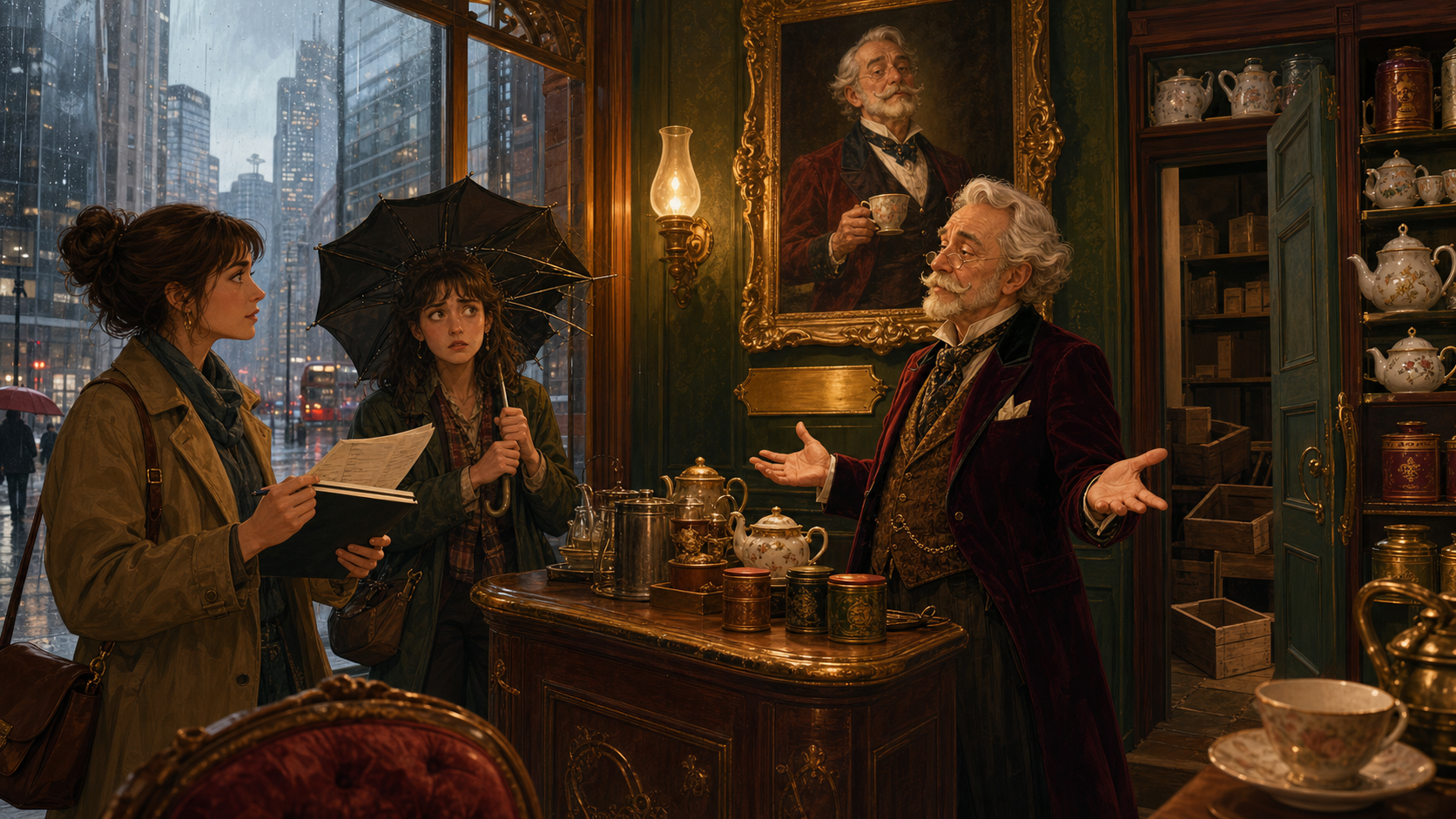
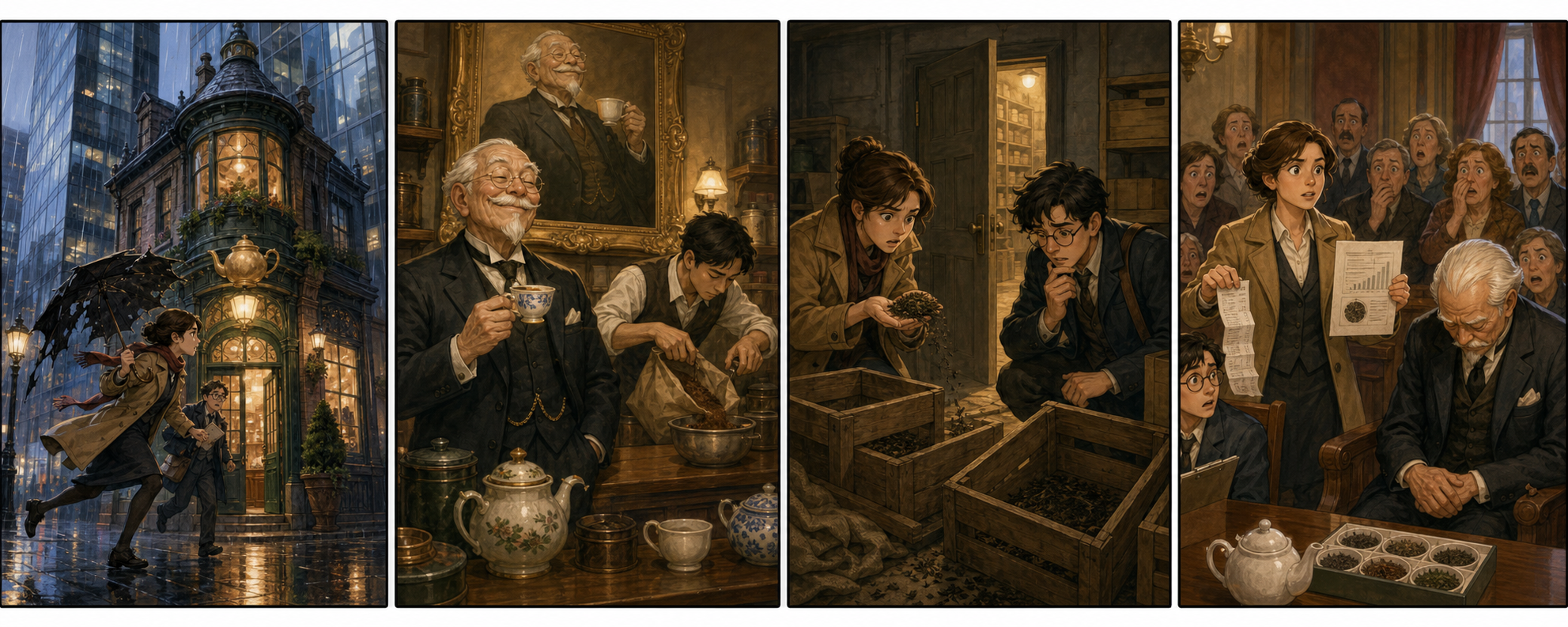
The Museum of Perfect Tea opened on a rainy Thursday, inside a narrow brick building that looked strangely anachronistic, as if someone had dropped a Victorian tea room into the middle of a city full of glass towers and electric buses.

Its owner, Mr. Vale, greeted every visitor with a soft smile. He seemed benign at first: gentle voice, silver hair, warm hands folded over his apron. But behind the counter, he had begun to adulterate his most expensive tea with cheap dried leaves and brown powder, then sell it as “mountain-grown imperial reserve.”

Mira, a young food journalist, arrived with her assistant, Theo, who rushed through the door with such alacrity that his umbrella turned inside out behind him.

“I found the invoices,” he whispered. “The good tea shipments stopped three months ago.”

Mira looked toward Mr. Vale, who was calmly serving an old couple. She felt ambivalent. The museum had been part of the city for fifty years. Her grandmother had brought her here as a child. She wanted to advocate for the customers who had been cheated, but she also dreaded destroying a place tied to so many memories.

Mr. Vale noticed her watching and approached.

“My dear Mira,” he said, “if there is any misunderstanding, I am entirely amenable to a conversation.”

His politeness was perfect. Too perfect.

On the wall behind him hung a huge portrait of himself, painted like a king. Under it, a gold plaque declared him “The Savior of Tea Culture.” Mira knew then that he did not merely want to run a successful shop; he wanted to aggrandize himself, to make his reputation larger and grander than the truth could support.

Theo stared at the plaque. “That is either audacious or insane.”

“Both,” Mira said.

The museum’s brochure was full of banal phrases: “Tea is life,” “Taste the past,” “A cup of wisdom.” But the prices were not banal. Mr. Vale was avaricious enough to charge two hundred dollars for a pot of leaves that cost him almost nothing.

When Mira asked to see the storeroom, he smiled.

“Of course.”

But the storeroom was nearly empty. The air was so dry that the remaining leaves had begun to desiccate in cracked wooden boxes. Theo touched one and it crumbled into dust.

Mr. Vale’s smile disappeared.

“You should be careful,” he said. “A young journalist can easily misunderstand what she sees.”

“I can construe an empty storeroom in several ways,” Mira said, “but none of them are flattering.”

That evening, before Mira could publish her article, an anonymous letter spread online accusing her of taking bribes from a rival tea company. It was pure calumny, but it moved fast. By morning, half the city was calling her corrupt.

At the public hearing, the mayor demanded decorum. No shouting, no insults, no dramatic gestures. Mr. Vale arrived in a velvet coat, looking offended but noble. Mira arrived with invoices, photos, and a lab report.

Mr. Vale’s lawyer stood first. His explanation was so convoluted that even the mayor rubbed his forehead. He spoke of seasonal variation, ceremonial blends, historical preservation, supplier transition, and “the philosophical instability of authenticity.”

Theo whispered, “Did he just say the tea is fake because truth is complicated?”

Mira tried not to laugh.

When it was her turn, she was candid. She did not exaggerate, did not perform outrage, did not hide her affection for the museum.

“I loved this place,” she said. “That is why this matters.”

Mr. Vale gave a caustic laugh. “How noble. A sentimental girl playing detective.”

The mayor frowned. “Mr. Vale, I will not allow you to castigate a witness for telling the truth.”

Then Mira’s lawyer, a small woman named Iris, stepped forward. She was calm, quick, and deft. With three receipts, two photographs, and one test result, she made the entire fraud visible in less than five minutes.

Mr. Vale’s lawyer rose. “I must demur. The evidence is being presented in a misleading emotional frame.”

“No,” Iris said. “It is being presented in chronological order.”

The room went quiet.

Mira showed the original advertisements. They were not even original; they were derivative, copied almost word for word from an old London tea house. Mr. Vale had stolen the language, inflated the story, and diluted the tea.

At last, the mayor asked Mr. Vale why he had done it.

For the first time, the old man looked small.

“I began by trying to save the museum,” he said. “Then I began to covet the admiration. The awards. The interviews. The portrait. I told myself the city needed me.”

His voice shook. Whether from shame or fear, Mira could not tell. He looked craven now, not majestic: a frightened man hiding behind velvet and gold leaf.

“Are you sorry?” the mayor asked.

Mr. Vale lowered his head. “Yes.”

But Mira watched carefully. His face was pale, his hands trembled, and his voice had lost its performance. For once, he seemed truly contrite.

The crowd, however, was incredulous. People had trusted him for decades. One woman stood and delivered a furious diatribe about birthdays, anniversaries, and retirement parties held over fraudulent tea.

Mr. Vale did not interrupt.

After the hearing, Theo looked at Mira with wide, almost ingenuous eyes.

“So people can build an entire life around tea,” he said, “and still lie about what is in the cup?”

Mira closed her notebook.

“Especially then,” she said. “The more beautiful the ritual, the easier it is to hide the powder.”

Back to top

Group 3

The One With Phoebe's Sacred Basil

Group 3 poster
Poster
Group 3 four-panel scene strip
Scene strip

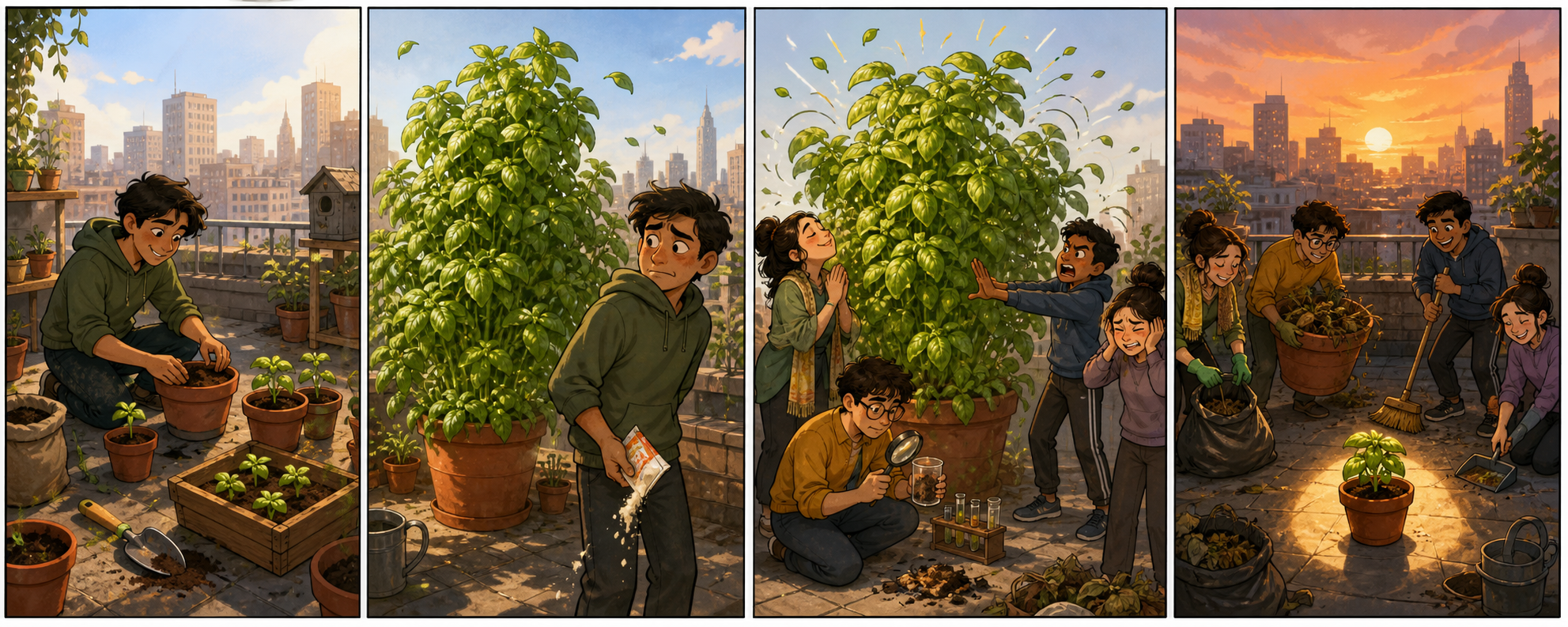
Phoebe decided that the roof above Monica’s apartment needed a bucolic corner: a peaceful little herb garden that could make New York feel, in her words, “less like concrete with rent.” She arrived with six basil seedlings, a wooden box of soil, and a sign that said Sacred Herb Sanctuary.

Ross noticed the problem first. The seedlings had begun to burgeon far too quickly, growing visibly during breakfast. To him, this was anomalous, not charming. Basil did not normally behave like it had a deadline.

Joey looked proud but nervous. He had “helped” by adding a powder he bought from a man outside the subway. The label was covered in arcane symbols, strange arrows, and a warning no one could translate. Joey gave everyone an artless smile, so innocent that it almost hid the terrible judgment behind it.

Monica’s anger rose, then slowly began to abate as she realized shouting would not make the plants smaller. Rachel tried to assuage Joey’s embarrassment, telling him his intentions were sweet even if his gardening method was illegal in spirit.

Phoebe, however, treated the basil with complete deference. She believed the plants were sensitive beings and placed a tiny scarf around the largest one. Within an hour, she had practically begun to canonize it, calling it Saint Basil and thanking it for “choosing this roof.”

Chandler developed immediate antipathy toward the plant after it made a sharp squealing noise. By noon, the rooftop was filled with a cacophonous chorus of whining leaves, rattling pots, and Ross explaining plant biology in a voice that became more verbose every minute.

Ross tried to contend that the powder had chemically overstimulated the roots. His explanation was surprisingly cogent: clear, logical, and supported by soil samples. Monica found it compelling enough to start wearing gloves.

But Phoebe refused to accept that her sanctuary was just bad chemistry. She began to equivocate, saying that “fake” depended on what society meant by “natural.” Chandler said that if a plant needed subway powder and espresso, nature had left the conversation.

The basil crisis began to polarize the group. Phoebe and Joey wanted to protect the plants. Monica wanted them removed. Ross wanted to study them. Rachel wanted the roof back before someone from the building complained.

Then Joey’s pocket began to leak brown dust. The second packet of powder fell out, along with a receipt for an absurd amount of money. Chandler called the purchase prodigal, because only Joey could spend grocery money making basil aggressive.

Joey looked diffident now, all his confidence gone. He admitted he had also given the plants espresso because “they looked tired.” His face betrayed the truth before he finished speaking: this was not his first experiment.

Phoebe’s disappointment hardened into formal censure. She did not yell. She simply declared that Joey had violated the spiritual boundaries of basil. Monica, who respected boundaries more than basil, approved.

Cleaning the roof became an arduous job. Monica organized the tools. Ross collected copious samples. Rachel redesigned the garden so it looked stylish instead of cursed. Chandler carried light pots while complaining as if they were stones. Joey apologized to each plant individually.

Ross briefly announced that he would live an ascetic life for one week to honor real nature: no coffee, no sugar, no unnecessary comfort. Everyone ignored this because he looked miserable after eight seconds.

Phoebe finally agreed to abjure fake miracles, strange powders, and anything sold by a man who said, “Don’t worry about the label.” Her earlier mystical excitement faded into something quieter and more sincere.

By sunset, their desultory panic had begun to coalesce into a plan. The damaged plants would go. The soil would be replaced. The roof would become a real garden, not a chemical opera.

The next morning, only one small basil plant remained. It did not glow, squeal, or grow during breakfast. It simply sat in the sunlight.

Phoebe smiled. “No saint. No miracle. Just basil.”

And for once, everyone was relieved by something ordinary.

Back to top
Group 4

The Rehearsal

Group 4 poster
Poster
Group 4 four-panel scene strip
Scene strip

Friends-style, Chandler + Joey. ~735 words, ~5 min audio.

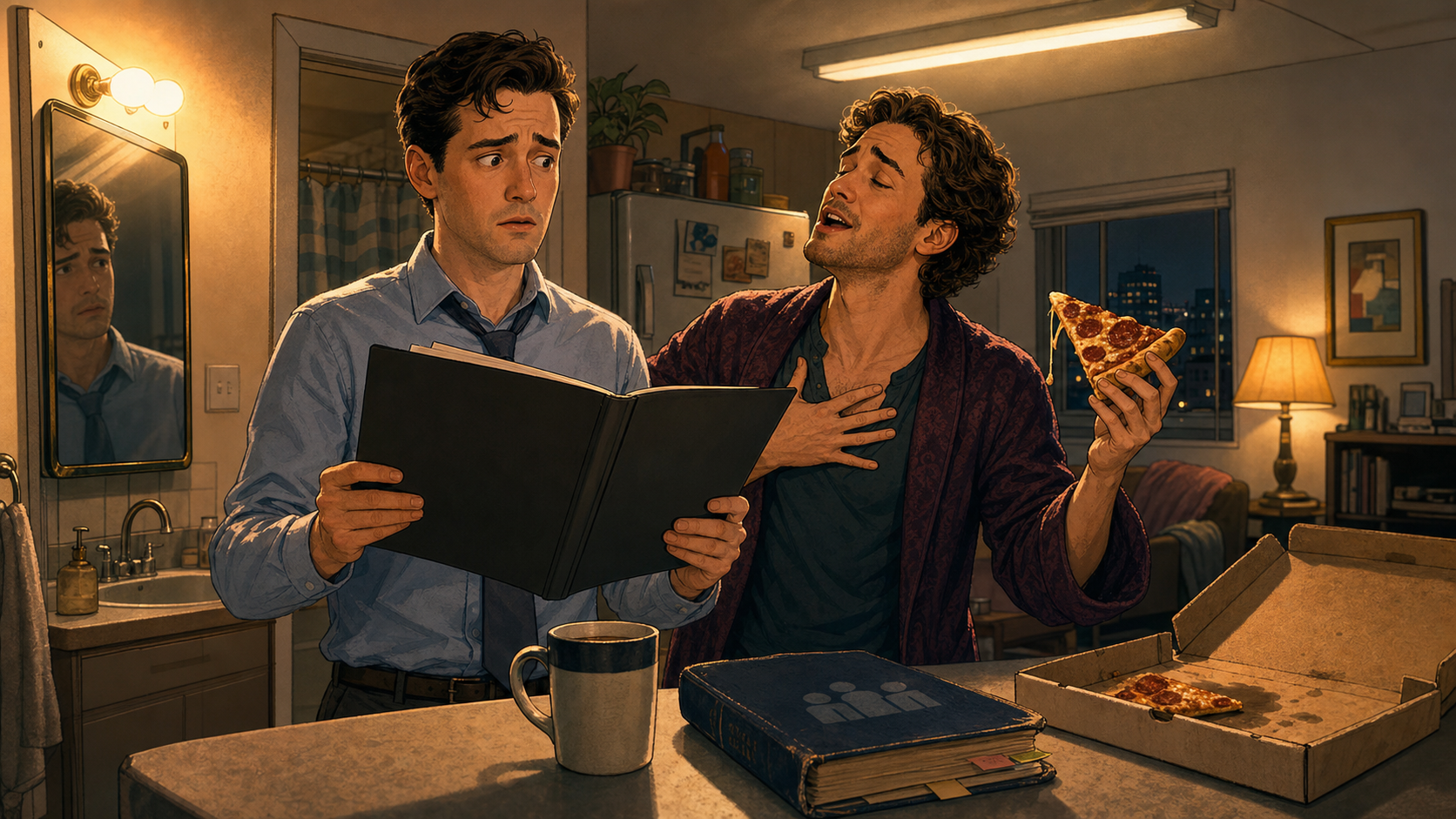
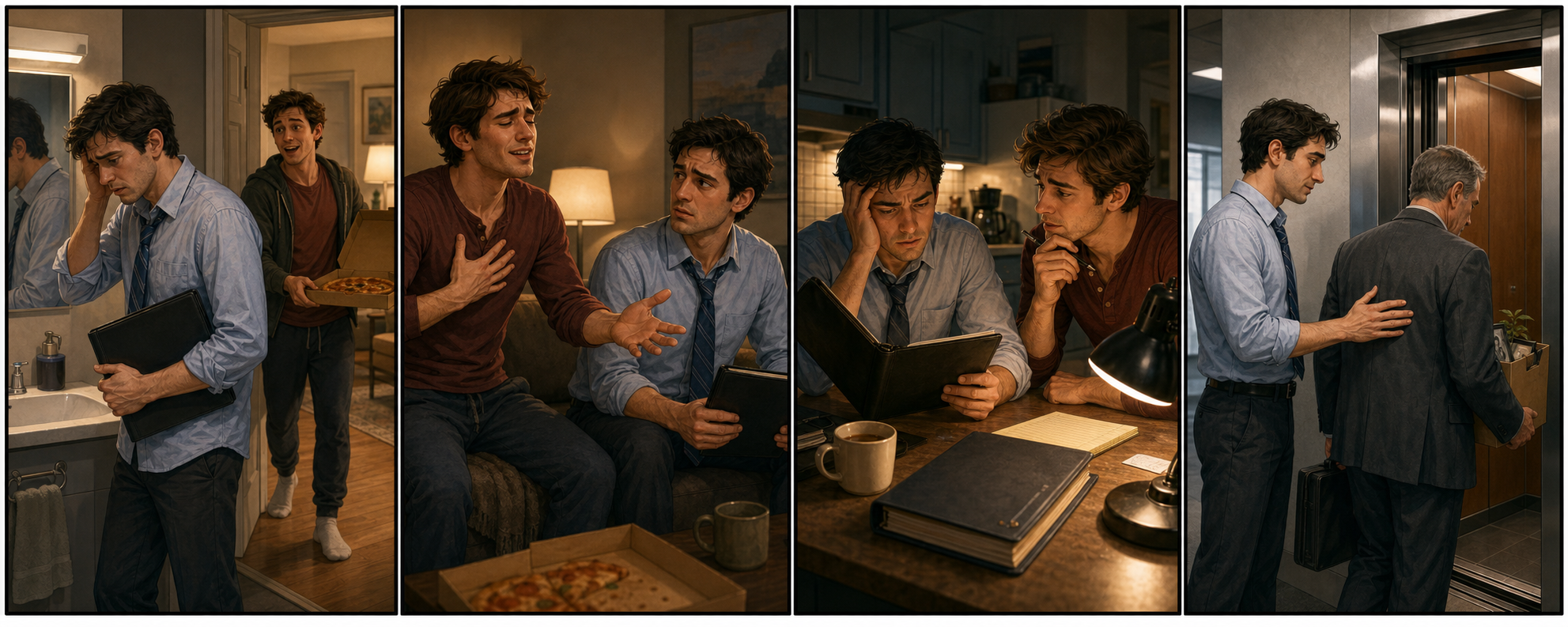
Chandler had been pacing in front of the bathroom mirror for twenty minutes when Joey walked in with a pizza. The folder in Chandler's hand said DOUG THOMPSON, TERMINATION. He shut it too fast.

Chandler had decided, some hours earlier, that it would be prudent not to explain to Joey what tomorrow actually was. Doug had been at the company twelve years. Chandler had six paragraphs of HR-approved phrasing and no idea how to say any of it out loud.

Joey watched him vacillate. Mouth opening. Closing. Opening again. He drew the wrong conclusion immediately.

"You're breaking up with her."

Chandler paused. He had, in fact, mentioned a date last week, vaguely, deflectively, and Joey had cherished the tiny piece of gossip like a squirrel with a nut. Chandler opened his mouth to correct him, and then didn't.

The HR script sat on the counter. It was opaque in a way Chandler had come to hate: phrases like "role redundancy" and "workforce optimization" that meant something devastating but sounded like weather. Joey's face, meanwhile, was already lit up with the earnest fervid conviction of a man who has watched a lot of daytime television.

"Sit down," Joey said. "I'm gonna help you."

Joey, once activated, became fully garrulous. He talked for eleven minutes without pause. Love, he explained, was ephemeral. Beautiful, fleeting, gone before you knew it. The goodbye had to honor that. You had to be intimate. You had to sit close. You had to look her in the eyes.

Chandler considered correcting him. Then he considered his HR paragraph, sharp and corporate and quietly incendiary, the kind of sentence Doug would replay for the rest of his career, and decided not to.

Joey stood, demonstrating. He dropped his voice, went placid, laid a hand over his heart. This, he announced, was the paradigmatic delivery. Chandler tried to emulate it and immediately felt insane.

"Try again."

Chandler tried again. Joey nodded, gave the tiniest approbation, adjusted his shoulders like a director.

They rehearsed the line about "different directions" seven times. Joey warned him it could sound polemical if he over-emphasized "different," like he was blaming her. Softer, Joey said. Mitigate it. Chandler, pedantic by nature, kept trying to swap "different directions" for HR's original "misalignment of trajectories," and Joey told him to stop using obsolete corporate phrases nobody said out loud.

The old HR handbook on the counter was, in fact, from 2011. Obsolete. Chandler didn't argue.

By eleven Chandler was enervated, slumped against the fridge. Joey brought coffee to invigorate him for one last run. The fluorescent kitchen light hummed, always inimical to concentration, and Joey finally switched it off in favor of the lamp, a rare gesture of restraint from a man who otherwise never lowered a light.

"Say the closing," Joey ordered.

Chandler said the closing. Joey pressed a hand to his shoulder with practiced, mock profundity and told him, with the calm of a man who had already predicted every beat, that Chandler was going to fumble it anyway. Not the words. The feeling. It landed as weirdly prophetic.

Chandler didn't sleep.

The apartment at six a.m. was falsely tranquil. Chandler left with the folder.

At the office, he tried to be scrupulous. He tried to be punctilious. He read HR's script cleanly, precisely, exactly as written, and then, at the very end, something in Joey's voice reached up through his throat, and Chandler heard himself tell Doug, softly, that he would always cherish what they had built.

Doug stared.

There was no way, later, to corroborate exactly what Chandler had meant. HR would want notes. Chandler had two disparate scripts in his bag, the corporate one and the Joey one, and neither of them explained the sentence he had actually said.

He did not precipitate the goodbye. He walked Doug to the elevator. He did not use the phrase "workforce optimization," which Joey would not have understood anyway; it was too recondite for real life. He did not abstain from apologizing, though HR had told him to.

He came home at four. Joey was on the couch with a sandwich, already prepared to grieve on his behalf.

"How'd she take it?" Joey asked.

Chandler sat down. He looked at the sandwich. He decided, for the third time that day, that some corrections were not worth making.

Back to top
Group 5

The Fake Antique

Group 5 poster
Poster
Group 5 four-panel scene strip
Scene strip

Friends-style, Phoebe + Ross. ~780 words, ~5.5 min audio.

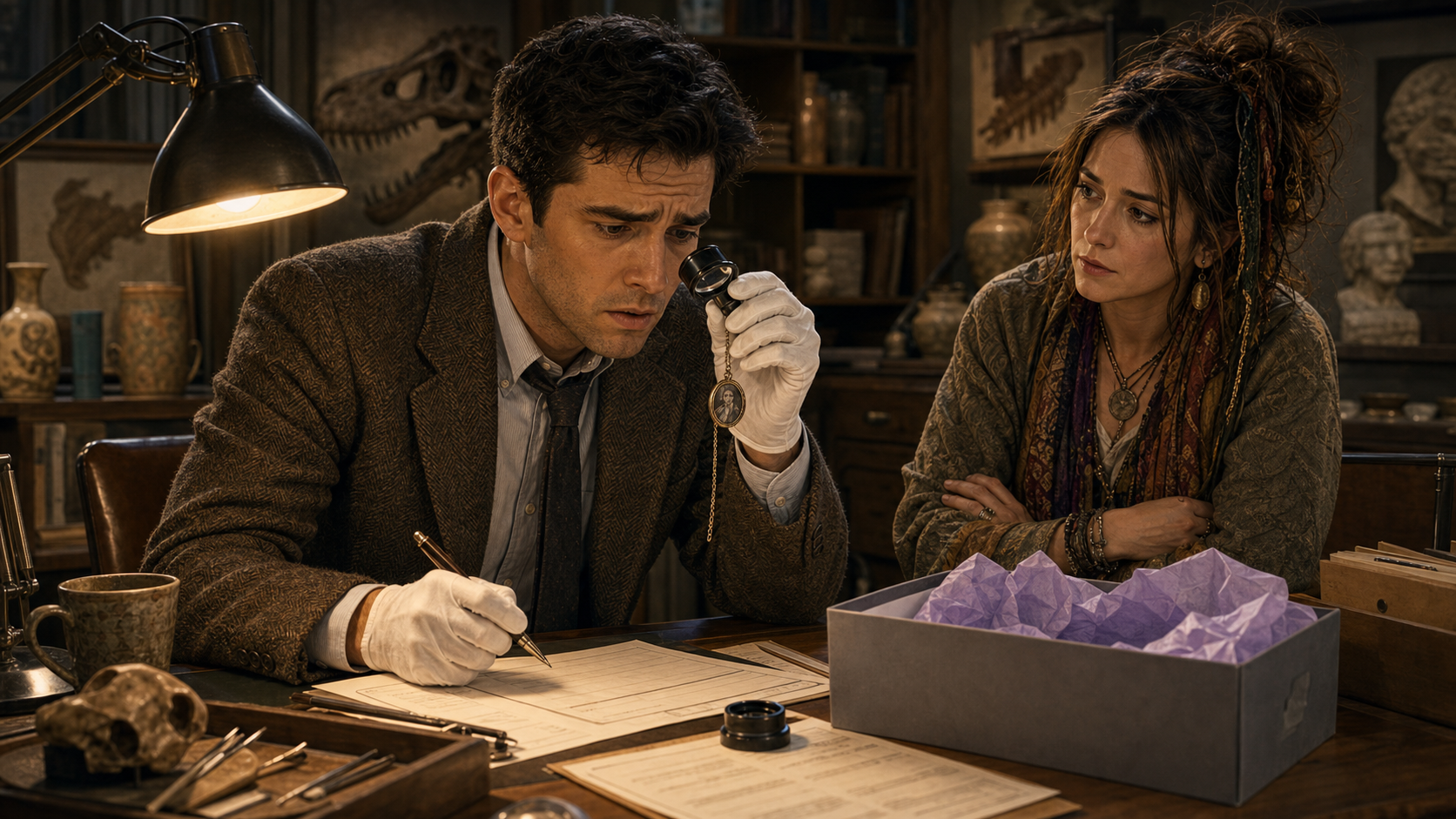
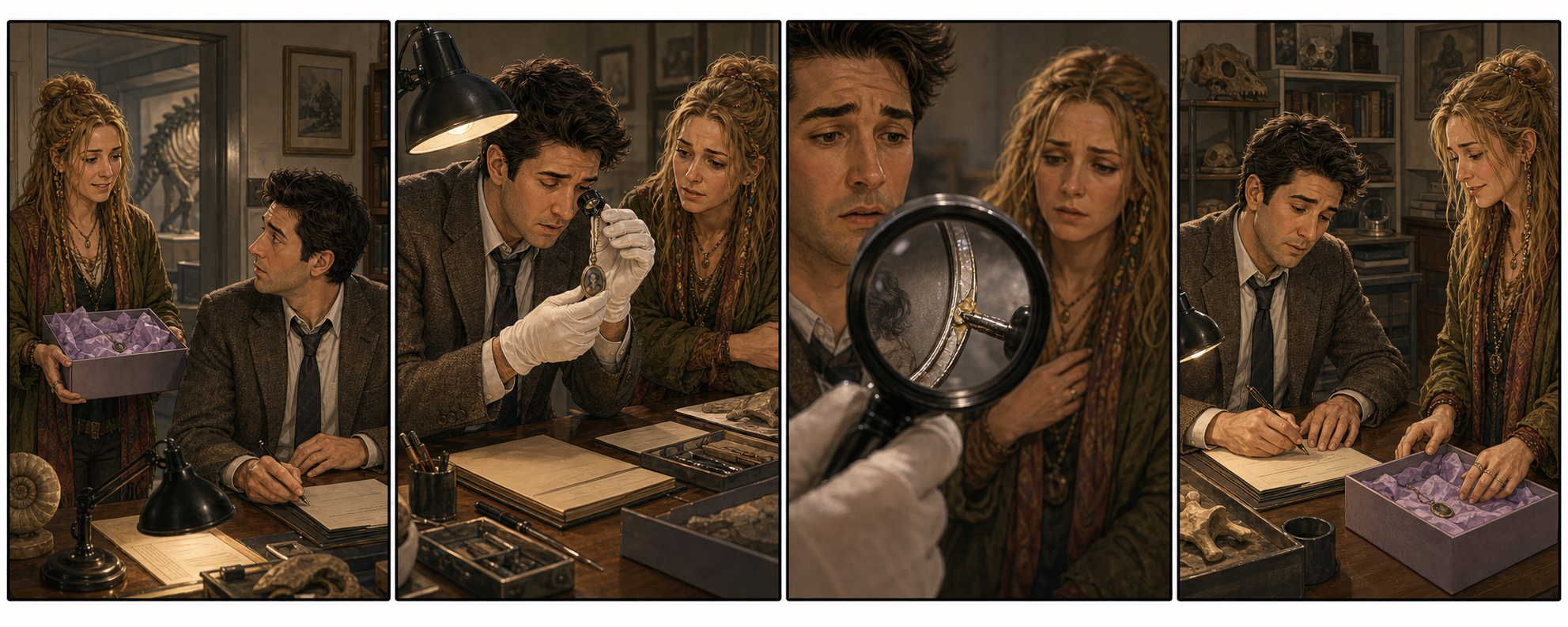
The pendant sat on Ross's desk in a Nike shoebox lined with lavender tissue. Phoebe had walked into the museum without an appointment and delivered the box with the sort of panache that made the security guard, briefly, forget his job.

"Saturday," she said. "The wedding is Saturday. I need this signed."

Ross, who had already been weary from a morning of fake donation letters, asked what the object was. Phoebe told him. It was, she explained, a family piece. Eighteenth century. Passed down through her estranged grandmother's side of the family, a woman Phoebe had met exactly once, in a hospice, a year before she died.

Ross opened the lid. The pendant was diminutive, smaller than Phoebe's palm and smaller, he suspected, than she had led the bride to believe. He put on his gloves.

"I need to run this through the conventional process," Ross said. That meant photographs, metal composition, provenance forms. Phoebe waved a hand, imperious, and told him to skip the forms. She was zealous about the object in a way that made Ross uneasy. Loving a thing was not the same as verifying it.

He started anyway. Ross's method was plodding and he did not apologize for it. Weight. Loupe. Micro-scratches. He read the inscription on the back, which was enigmatic, half worn, and included at least one letter that was not a letter in any alphabet he knew.

Phoebe's origin story, offered without prompting, was fanciful and extravagant. There were tsars in it. There was a horse. There was, at one point, a house fire that only the pendant survived. Ross wrote none of it down, which she noticed.

"You're being aloof."

"I'm being professional," Ross said, though he was, in fact, being aloof. Under the desk lamp, the pendant's materials were heterogeneous in a way real eighteenth-century work almost never was. Two different silvers. A backing that looked, to Ross's trained eye, like something poured in the 1960s. The prosaic version, he suspected, was that someone had bought parts from an estate sale and glued them.

He asked Phoebe, carefully, where she had actually gotten it. She stiffened. The question landed as impertinent, and she told him so.

Overhead, the fluorescent panel flickered sporadically, a small clangor every time a truck passed on the street below. Phoebe grew restive, tapping the shoebox lid. Ross's questions were slowly becoming invasive, and both of them knew it.

He kept going. The seam where the two silvers met was barely discernible without a loupe, but it was there. Glue. Someone had assembled the pendant from parts, and not long ago.

"Ross."

"One more test."

The one more test was decisive. Ross was utterly certain now. The object was, in the language of his field, a composite of dubious origin. He could debunk the entire family story in three sentences. His pen was already on the certificate line.

Then he stopped.

He looked at Phoebe, who was very quiet, which was not a Phoebe thing. He realized he had been treating the appointment as a remedial lesson in metal dating, explaining basic chemistry to a woman who had not asked. He realized he had been about to call something she loved frivolous in writing, which would stigmatize the gift and, by extension, the bride, and, by extension, Phoebe.

He realized, with a small internal wince, that he had been marginalizing the reason she was here. She had not walked into his office for a metallurgic report. She had walked in because a woman she barely knew had, once, in a hospice bed, put this thing into her hand and called it hers.

Ross's own professionalism had been about to undermine something that had nothing to do with authenticity.

He set the pen down.

He was, briefly, irresolute. The museum's authentication rules were lax enough that he could, technically, sign almost anything and no one would check. That was not, however, a laudable solution.

Instead he took out a fresh sheet of museum letterhead. He wrote, in careful academic hand, a paragraph. The paragraph said that the pendant had been received by Phoebe from a member of her family, that it had been treasured across at least one generation on the basis of that transmission, and that its emotional provenance was, in his professional opinion, unambiguous. He signed it. He stamped it.

He handed it across the desk. Phoebe read it twice. She did not thank him, exactly, but she folded the paragraph into the shoebox with the pendant, next to the lavender tissue, and closed the lid gently.

At the door she turned.

"You're less of a jerk than people think."

Ross accepted this. It was, from Phoebe, high praise.

Back to top